
Dashavtar Stotra (Pralaya Payodhi Jale) — full paath and English meaning
'Pralayapayodhijale' is the first song of poet Jayadev's Geet Govind. Each verse describes one avatar of Vishnu — Matsya, Kachchhap, Varaha, Narasimha, Vamana, Parashurama, Rama, Balarama, Buddha and Kalki — with the refrain 'Keshava dhrita… Jaya Jagadisha Hare'.
On Ekadashi and in Vishnu puja — along with Om Jai Jagdish Hare.
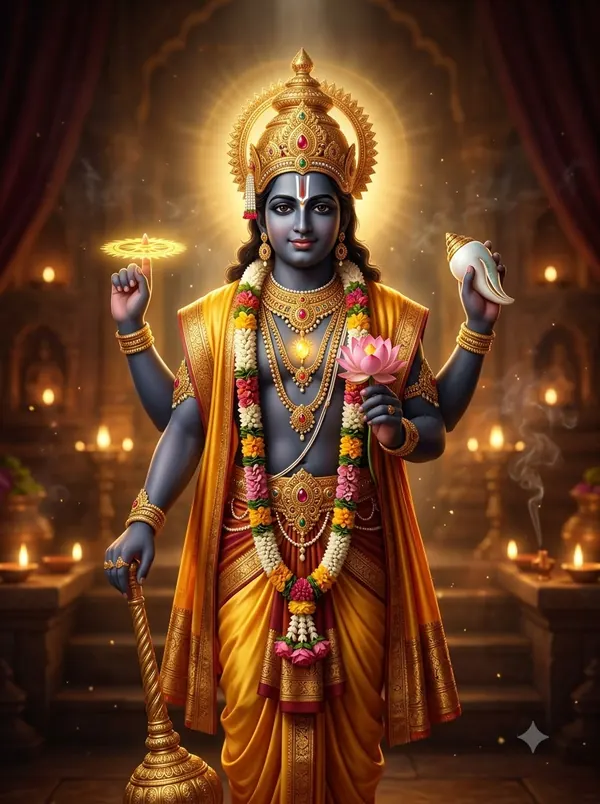
Pralayapayodhijle dhritavansi vedam
Vihitavahitracharitramakhedam ।
Keshav dhritaminashrir jai jagdish hare ॥
In the ocean of the great deluge you tirelessly carried the Vedas like a boat — O Keshava, Jagadish Hari who took the Matsya (fish) form, victory to you.
Kshitirih vipultare tishthati tav prishthe
Dharanidharanakinachakragarishthe ।
Keshav dhritakachchhprup jai jagdish hare ॥
On your vast back, marked round from bearing the world, this earth rests — O Keshava, Jagadish Hari in the Kachchhap (tortoise) form, victory to you.
Vasti dashanashikhre dharni tav lagna
Shashini kalankaklev nimagna ।
Keshav dhritasukarrup jai jagdish hare ॥
The earth resting on the tip of your tusk looks like the mark on the moon — O Keshava, Jagadish Hari in the Varaha (boar) form, victory to you.
Tav karakamalvare nakhamadbhutashringam
Dalitahiranyakashiputanubhringam ।
Keshav dhritanaraharirup jai jagdish hare ॥
The wondrous sharp nails of your lotus hands tore Hiranyakashipu's body as easily as a bee — O Keshava, Jagadish Hari in the Narasimha form, victory to you.
Chhalyasi vikramne balimadbhutavaman
Padanakhanirajanitajanapavan ।
Keshav dhritavamanrup jai jagdish hare ॥
O wondrous Vamana, with three steps you outwitted King Bali; the Ganga flowing from your toenail purifies all — O Keshava, Jagadish Hari in the Vamana form, victory to you.
Kshatriyarudhirmaye jagadapagatapapam
Snapyasi paysi shamitabhavatapam ।
Keshav dhritabhrigupatirup jai jagdish hare ॥
With the blood of tyrant kshatriyas you freed the world of sin and calmed its suffering — O Keshava, Jagadish Hari in the Parashurama form, victory to you.
Vitrasi dikshu rane dikpatikamaniyam
Dashamukhamauliblin ramaniyam ।
Keshav dhritaramashrir jai jagdish hare ॥
In battle you offered Ravana's ten heads to the guardians of the directions — O Keshava, Jagadish Hari in the Rama form, victory to you.
Vahsi vapushi vishde vasanan jaladabham
Halahatibhitimilitayamunabham ।
Keshav dhritahaladharrup jai jagdish hare ॥
On your fair body you wear cloud-blue garments, as if the Yamuna, afraid of your plough, came to meet you — O Keshava, Jagadish Hari in the Balarama form, victory to you.
Nindasi yagyavidherhah shrutijatam
Sadayahridayadarshitapashughatam ।
Keshav dhritabuddhshrir jai jagdish hare ॥
With a compassionate heart you condemned the killing of animals in yagyas — O Keshava, Jagadish Hari in the Buddha form, victory to you.
Mlechchhnivahanidhne kalyasi karavalam
Dhumaketumiv kimpi karalam ।
Keshav dhritakalkishrir jai jagdish hare ॥
To destroy the hordes of the wicked you raise a sword fearsome as a comet — O Keshava, Jagadish Hari in the Kalki form, victory to you.
Shrijayadevakaveridamuditamudaram
Shrinu sukhadan shubhadan bhavasaram ।
Keshav dhritadashavidhrup jai jagdish hare ॥
Hear this noble stuti told by poet Jayadev, giver of happiness and good, the essence of the world — O Keshava, Jagadish Hari of ten forms, victory to you.
Vedanuddhrte jaganti vahte bhugolamudbibhrate
Daityan daryate balin chhalyate kshatrakshayan kurvate ।
Paulastyan jayte halan kalyate karunyamatanvate
Mlechchhanmurchchhayte dashakritikrite krishnay tubhyan namah ॥
Rescuer of the Vedas (Matsya), bearer of the world on his back (Kachchhap), lifter of the earth (Varaha), tearer of the demon (Narasimha), deceiver of Bali (Vamana), destroyer of the kshatriyas (Parashurama), conqueror of Ravana (Rama), bearer of the plough (Balarama), spreader of compassion (Buddha) and stunner of the wicked (Kalki) — O Krishna of ten forms, I bow to you.
The paath of Dashavtar Stotra (Pralaya Payodhi Jale) is complete.
Send to someone on WhatsAppThe text is traditional and the wording differs slightly from region to region. The meanings are written in simple English by OmKiran Bhakti. If you spot a mistake, tell us with a comment on YouTube.